Free · No account required

Parameterize the real-world
disruption layer of ReliaSim

TTF — Uptime TTR — Repair Time (min) → PDF ↑

Traditional models simulate what machines are designed to do. ReliaSim's interrupt construct models what actually happens — stochastic failures and repairs that dynamically override nominal behavior, exposing system performance invisible to steady-state analysis. ReliaStats gives you the tools to parameterize that disruption layer with precision — directly in your browser, no install required.

Runs entirely in your browser — data never leaves your machine

🔒 Your data never leaves your machine
No install required
🌐 Any browser
🆓 Free to use
The parameterization challenge

Accurate models start with accurate distributions

Every interrupt captures a real-world disruption — a stochastic event that overrides nominal machine behavior. Each is defined by two distributions: how long a node runs before the event occurs (TTF) and how long recovery takes (TTR). Getting these right is the difference between a simulation that reveals true system dynamics and one that misleads.

"Traditional methods of parameterizing interrupts require dedicated time and attention from an expert to manually manipulate the tape and use their knowledge to distill line event data into cause groups — each with unique TTF and TTR distributions. The process is time-consuming, expensive, and requires an expert."
— ReliaSim documentation on interrupt parameterization
📉

TTF controls interruption frequency

Time to Failure defines how long a node operates before an interrupt occurs — random breakdowns, scheduled downtime, wear-out conditions, or volume-based triggers.

🔧

TTR determines how disruptive failures are

Time to Repair defines how long a node is unavailable once interrupted — maintenance, resets, refills, or operator response. Together, TTF and TTR define the reliability profile.

🎯

ReliaStats puts the power in your hands

Design distributions from scratch, explore fitted parameters, or compare versions side by side — no expert required, no data uploaded.

The heart of ReliaStats

LEDS Data to Fitting Engine

The engine that turns raw Line Event Data (LEDS) into parameterized interrupt distributions — automatically, accurately, and without requiring an expert modeler.

The problem

Traditional interrupt parameterization requires dedicated time and attention from an expert. Manual distribution fitting from event logs is slow, expensive, and scarce — a hard bottleneck for anyone who wants a validated production model.

What the engine does

Take a raw event tape in. Get parameterized TTF and TTR distributions out — mapped to cause groups, ready for ReliaSim. The expertise is built into the engine, not rented from a consultant.

Input
LEDS
Line Event Data
Engine
Fitting Engine
auto cause-group + distribution fit
Output
Parameterized
TTF / TTR → ReliaSim

"The power to start with a raw tape and produce parameterized interrupts quickly, accurately, and easily has been placed in any user's hands."

Where ReliaStats fits

The key to the ReliaSim process

ReliaStats owns the data integration step — converting raw event history into parameterized interrupt distributions, then closing the loop by validating simulation results against the same history.

🗺️
Step 1
Build
Define the production line in ReliaSim and parameterize each machine's interrupt behavior from raw historian event data.
ReliaStats
Step 2
Validate
Confirm simulation results match real line performance — to within 1% statistical accuracy. Distributions built from time series that faithfully capture real equipment behavior.
🚀
Step 3
Decide
Experiment with what-if scenarios and commit capital where the validated model says it belongs — without touching the line.
Four components, one workflow

From raw event data to validated ReliaSim parameters

Design and understand distributions for free. Fit raw historian data with ReliaStats. View and compare the results — also free.

Line Event Data historian CSV ReliaStats design · fit · validate Interrupts TTF + TTR distributions ReliaSim simulate baseline sim output Interrupt Summary results validate
Inside ReliaStats

Five tools — one workspace

Design, fit, view, and compare interrupt distributions — then validate that ReliaSim's output matches the historian you fit from. Four tools free, forever. Only historian fitting requires a ReliaStats subscription.

Interrupt Designer

Build a TTF + TTR pair from scratch. Explore what distribution choices mean in practice before committing to a fit.

  • Working / Failed state timeline over a configurable shift window
  • Box-and-whisker: p5, Q1, Median, Q3, p95
  • Switch timeline scenario: Mean, Median, Q1, Q3, or p95
  • PDF, CDF, and Survival curves for TTF and TTR
  • Availability % from Mean TTF and Mean TTR

Interrupt Fitting

Upload raw historian event logs. ReliaStats automatically identifies failure and repair patterns, fits the best distribution for each interrupt, and exports a ReliaSim-ready file.

  • Import raw failure & repair event logs
  • Automatic cause group identification
  • Goodness-of-fit tests (K-S, Anderson-Darling)
  • Distribution ranking and model selection
  • Export fitted interrupt file for ReliaSim

Interrupt Viewer

Load any ReliaSim interrupt file and browse every interrupt. Click a row to inspect its uptime and downtime distributions — fast audit of a full model's parameterization.

  • All 8 ReliaSim distribution types supported
  • Box-and-whisker percentile strip per distribution
  • PDF, CDF, and Survival function views

Interrupt Comparison

Two interrupt files side by side. Differences color-coded by severity; curves overlaid for direct inspection.

  • Color-coded rows by % change
  • Overlaid PDF / CDF / Survival curves
  • Every numeric difference surfaced automatically
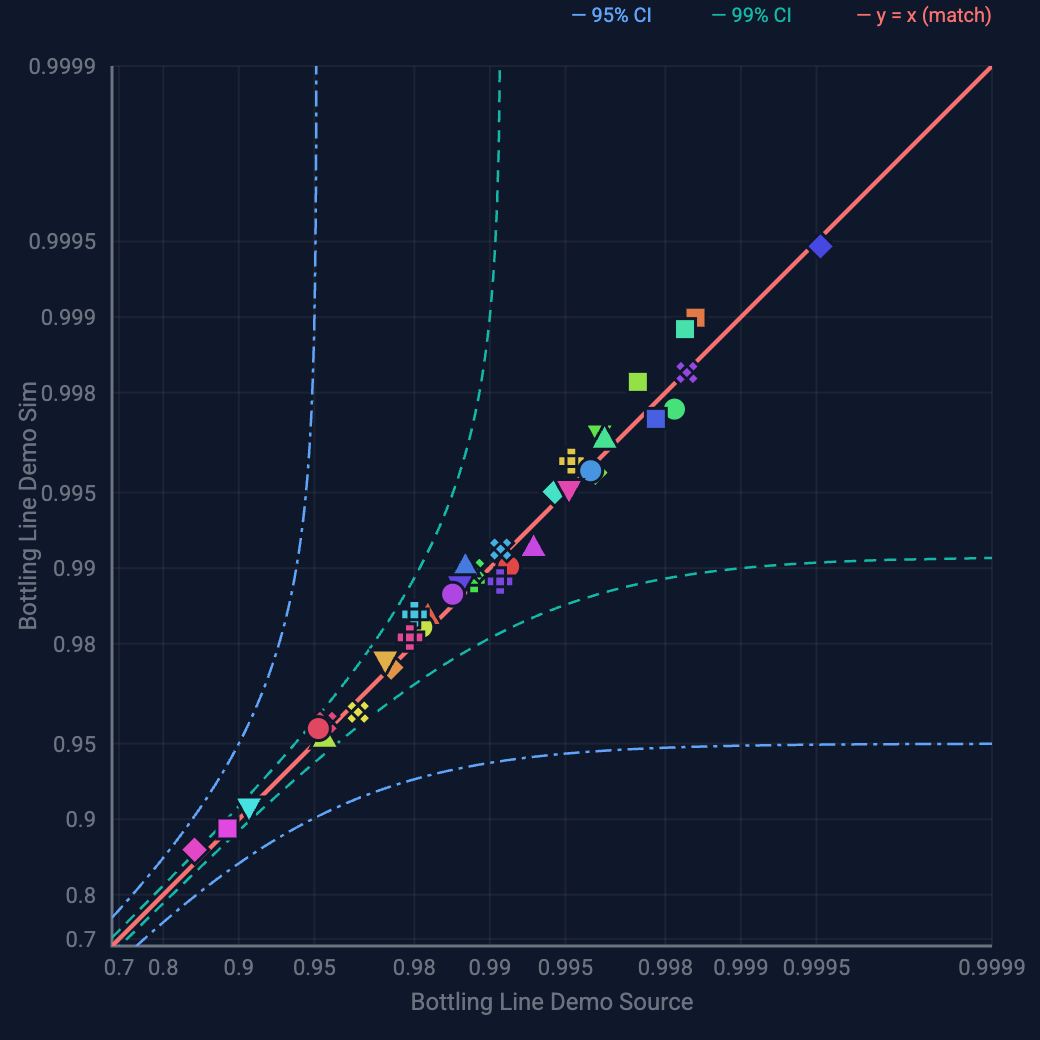
Interrupt Validation scatter — source vs. sim availability with 95% PI and 99% CI bands

Interrupt Validation

Validate against history — within 1%. Each point is an interrupt; on the diagonal = the sim matches the historian. ReliaSim's output cycles back here for comparison — refine and re-run until every interrupt lands on the line.

  • Source vs. sim availability, interrupt by interrupt
  • 95% PI / 99% CI bands flag outliers instantly
  • Closes the fit → simulate → validate loop
Distribution support

All 8 ReliaSim distribution types

Every distribution ReliaSim supports, parameterized exactly as ReliaSim stores them — including real-space mean/std for LogNormal.

κ<1 κ=1 κ>1
Weibull
λ (scale), κ (shape), γ (location)
Shape κ<1 = infant mortality, κ=1 = random, κ>1 = wear-out. Most versatile reliability distribution.
Wear-out · Random failures
LogNormal
mean (x̄), std dev (s)
Right-skewed — most values small, occasional large outliers. Ideal for variable repair durations.
Repair times · Compounded delays
Normal
μ (mean), σ (std dev)
Symmetric around mean. Use carefully for TTF — allows negative values unless constrained.
Consistent human-driven processes
Exponential
λ (rate) · mean = 1/λ
Memoryless — failure probability doesn't increase with age. Constant failure rate.
Random independent failures
Uniform
min, max
Equal probability across a range. Useful when failures can occur anywhere but no single value is preferred.
Limited data · Bounded range
Triangular
min, max, mode
Simple 3-point estimate. Easy to communicate to non-statisticians when only expert estimates are available.
Expert estimates · Quick modeling
Johnson SU
γ, δ, ξ, λ
Highly flexible 4-parameter system. Handles skewed and heavy-tailed behavior that simpler distributions can't capture.
Complex empirical data
Fixed / Schedule
x (value)
Deterministic — always returns the same value. Models predictable scheduled events with zero variance.
Shift changes · Planned maintenance
Reliability Engineering Fundamentals

The Bathtub Curve

Every component follows a failure rate pattern over its lifetime. Identifying which phase your equipment is in determines the right distribution — and the right intervention.

Time → Failure Rate λ(t) Infant Mortality Random Failure Wear-out κ < 1 κ = 1 κ > 1
Infant Mortality
Weibull (κ < 1)

Defects, installation errors, and manufacturing variation cause early failures that decrease over time. The component is most likely to fail shortly after being put into service.

In the Designer, a Weibull with κ < 1 captures this behavior — the hazard function is highest at t=0 and falls as the weak units fail out.

→ Burn-in testing  ·  Strict incoming QA  ·  Early replacement schedules
Random Failure
Exponential · Weibull (κ = 1)

Failures occur independently of age — external shocks, operator error, voltage spikes, random environmental events. The failure rate is constant: knowing how long a component has run tells you nothing about when it will fail next.

This is the "useful life" phase. The Exponential distribution (memoryless property) is the canonical model.

→ Redundancy design  ·  Condition monitoring  ·  Failure mode analysis
Wear-out
Weibull (κ > 1) · LogNormal

Fatigue, corrosion, erosion, and material degradation cause the failure rate to increase with age. Failures become more predictable — and preventable — as the component approaches end of life.

Weibull with κ > 1 fits wear-out well. κ = 2–3 is common for mechanical fatigue; higher κ reflects tighter failure clustering.

→ Scheduled replacement  ·  Life-limit programs  ·  Predictive maintenance

ReliaStats Designer lets you select and parameterize the exact distribution that matches your equipment's phase — then see the impact on availability before touching a single setting in ReliaSim.

Open the Designer →
The ReliaStats product family

From distribution design to full automated fitting

ReliaStats Designer gives any engineer the tools to work with interrupt distributions. ReliaStats adds automated fitting from raw historian event data — replacing the expert-intensive manual process with one that anyone can run.

ChiAha
ReliaStats
Convert a raw historian event tape into parameterized ReliaSim interrupts — quickly, accurately, and without needing an expert.
  • Everything in Free
  • Import raw failure & repair event logs
  • Automatic cause group identification
  • Automated distribution fitting
  • Goodness-of-fit tests (K-S, A-D)
  • Model ranking and selection
  • Export fitted CSV for ReliaSim
🔒 Fitting runs in the cloud on anonymized numeric data only — interrupt names and descriptions are never transmitted.
◎ Coming soon
ChiAha
ReliaSim
Discrete-event reliability simulation engine. Models machine performance using interrupt-driven TTF and TTR distributions — within 1% statistical accuracy.
  • Discrete-event simulation engine
  • Interrupt-based reliability modeling
  • Availability, throughput, efficiency output
  • Buffer trade-off analysis
  • CSV parameter import from ReliaStats
Learn more →
Industries

Built for high-speed, high-volume operations

Wherever reliability data drives production decisions — ReliaStats helps you parameterize it right.

Food & Beverage Consumer Packaged Goods Pharmaceutical Oil & Gas Mining Electronics Chemical Processing Bulk Material Handling Pulp & Paper
"Before ChiAha, it would take me up to a month to develop a digital twin for a production line. ChiAha streamlines this process, making it faster and more straightforward while still delivering high-quality results."
— Tom Lange, Technology Optimization & Management LLC · 36 years, Procter & Gamble · Co-author, "High Accuracy Discrete Rate and Reliability Modeling" (Winter Simulation Conference 2020)

The underlying methodology has been validated by 300+ organizations across food & beverage, pharma, aerospace, defense, and energy since 1995. Current customers include Essity and Process Partners.

Start getting your Interrupt parameters right

No account. No install. Load a CSV or open the designer and start building.

Launch Designer → See ReliaSim — Simulate & Decide →

Ready to simulate? Your ReliaStats parameters plug directly into ReliaSim.

Book a live walkthrough →
Stay connected

Join our list

Product updates, case studies, and fresh insights — straight to your inbox. No spam.